


 PDF Version Demo
Snowflake certification SPS-C01 exam is an important IT certification exam. But, it is not easy to pass SPS-C01 exam and get the certificate. Here, we would like to recommend ITCertKey's SPS-C01 exam materials to you. With the help of the SPS-C01 questions and answers, you can sail through the exam with ease.
ITCertKey is a good website that provides all candidates with the latest and high quality IT exam materials. Snowflake SPS-C01 braindumps on ITCertKey are written by many experienced IT experts and 99.9% hit rate. If you don't have time to prepare for SPS-C01 or attend classes, ITCertKey's SPS-C01 study materials can help you to grasp the exam knowledge points well. By using ITCertKey, you can obtain excellent scores in the Snowflake Certification SPS-C01 exam.
ITCertKey Snowflake SPS-C01 braindumps are formulated by professionals, so you don't have to worry about their accuracy. They will efficiently lead you to success in Snowflake certification exam. We provide you with the latest PDF version & Software version dumps and you just need to take 20-30 hours to master these SPS-C01 questions and answers well. Our Software version dumps are the SPS-C01 test engine that will give you SPS-C01 real exam simulation environment.
ITCertKey will offer all customers the best service. We will give all customers a year free update service. Within one year, if the SPS-C01 practice test you have bought updated, we will automatically send it to your mailbox. If you don't pass your SPS-C01 exam, you just need to send the scanning copy of your examination report card to us. After confirming, we will give you FULL REFUND of your purchasing fees.
What's more, we provide you with the SPS-C01 free demo. Before you decide to buy the materials, you can download some of the SPS-C01 questions and answers.
Snowflake SPS-C01 Exam Syllabus Topics:
| Section | Weight | Objectives |
|---|---|---|
| Topic 1: Snowpark API and Development | 30% | - Multi-language support
|
| Topic 2: Performance and Best Practices | 10% | - Optimization techniques
|
| Topic 3: Snowpark Concepts and Architecture | 25% | - Snowpark architecture and execution model
|
| Topic 4: Data Transformations and Operations | 35% | - User-defined logic
|
Snowflake Certified SnowPro Specialty - Snowpark Sample Questions:
Question 1
You have a Snowpark Python application that reads data from a Snowflake table, performs several transformations, and then writes the results back to a new Snowflake table. The transformations involve complex calculations and aggregations. During testing, you observe that the application is consuming a significant amount of credits. Which of the following optimization strategies would be MOST effective in reducing the credit consumption of your Snowpark application?
A. Convert all Python User-Defined Functions (UDFs) to Java User-Defined Table Functions (UDTFs) for improved performance.
B. Minimize the amount of data transferred between Snowpark and Snowflake by pushing down transformations and using stored procedures where appropriate.
C. Use the 'cache()' method on intermediate Snowpark DataFrames to avoid recomputation of transformations.
D. Disable auto-scaling on the Snowpark-optimized warehouse to prevent it from scaling up unnecessarily.
E. Optimize the SQL queries generated by Snowpark by explicitly specifying join hints and using appropriate indexes.
Question 2
You are tasked with building a machine learning pipeline in Snowpark to predict customer churn. You plan to use the scikit-learn library for model training and want to deploy the trained model as a Snowpark UDF for real-time scoring. Consider the following code snippet:
A. The code will fail because the 'moder object cannot be directly serialized and passed to the UDE A different serialization method (e.g., pickle) is required.
B. The code will fail because scikit-learn is not a supported library for Snowpark UDFs by default, and needs to be explicitly added to the session imports.
C. The code will fail because the trained model needs to be saved to a stage and loaded within the UDF, rather than being passed directly.
D. The code will fail because the return type of the UDF is not explicitly defined. Snowpark requires explicit type hints for UDF return values.
E. The code will execute successfully and create a UDF that predicts churn using the trained model.
Question 3
You have a Snowpark DataFrame containing customer transaction data'. Your goal is to save this DataFrame as a set of Parquet files in an existing Snowflake stage named , partitioned by the 'transaction_date' column. You want to ensure that the files are automatically compressed using the Zstandard codec and that existing files with the same name are overwritten. Which of the following Snowpark code snippet achieves this with the most optimal approach and respects best practices?
A. Option C
B. Option B
C. Option A
D. Option E
E. Option D
Question 4
You are tasked with creating a Snowpark DataFrame from a Python list of tuples. Each tuple represents a customer record with the following structure: '(customer_id, signup_date, The 'customer _ id' should be an integer, 'signup_date' should be a date, and should be a decimal. You want to define the schema explicitly for type safety and performance. Which of the following code snippets correctly defines the schema and creates the Snowpark DataFrame?
A. 
B. 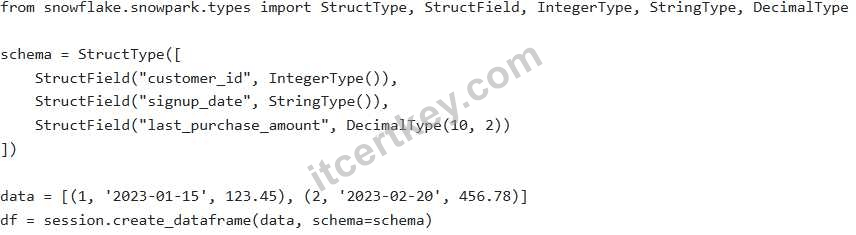
C. 
D. 
E. 
Question 5
You are working with a Snowpark DataFrame representing sensor data. The DataFrame contains columns like 'timestamp', 'sensor id' , and 'value'. You need to perform a complex windowing operation to calculate the moving average of the 'value' for each 'sensor id' over a 5-minute window, but only for data points where the 'value' is greater than a threshold. The window should be defined based on the 'timestamp' column. What is the most efficient and correct approach to implement this using Snowpark DataFrames?
A. Use a loop to iterate over each 'sensor_id' , filter the DataFrame for that sensor, calculate the moving average using Pandas windowing functions, and then combine the results.
B. First, collect the entire DataFrame into a Pandas DataFrame, then use Pandas windowing functions to calculate the moving average.
C. Create a UDF that takes a list of timestamps and values as input and returns the moving average. Apply this UDF to the entire DataFrame.
D. First apply the moving average calculation to the DataFrame and then filter for rows with values exceeding the threshold, since calculations are performed in order.
E. Use a combination of 'filter' to apply the threshold condition, 'Window.partitionBy' and 'Window.orderBy' to define the window, and 'avg' window function to calculate the moving average.
Solutions:
| Question 1 Answer: A,B | Question 2 Answer: A | Question 3 Answer: C | Question 4 Answer: C | Question 5 Answer: E |


 918 Customer Reviews


 Quality and ValueITCertKey Practice Exams are written to the highest standards of technical accuracy, using only certified subject matter experts and published authors for development - no all study materials.
 Tested and ApprovedWe are committed to the process of vendor and third party approvals. We believe professionals and executives alike deserve the confidence of quality coverage these authorizations provide.
 Easy to PassIf you prepare for the exams using our ITCertKey testing engine, It is easy to succeed for all certifications in the first attempt. You don't have to deal with all dumps or any free torrent / rapidshare all stuff.
 Try Before BuyITCertKey offers free demo of each product. You can check out the interface, question quality and usability of our practice exams before you decide to buy.